
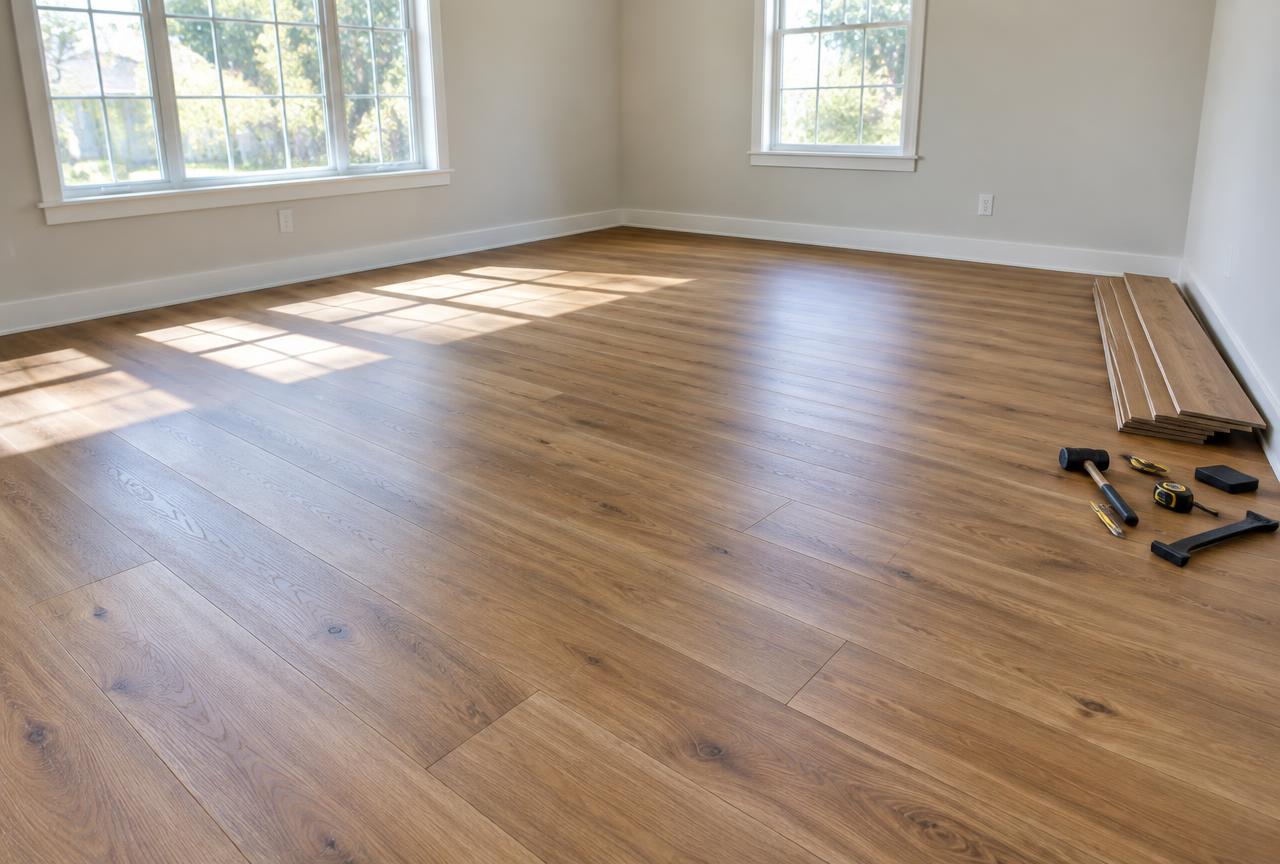
Luxury vinyl plank has a plastic core, so spills and damp basements don't swell it — that makes it the safer pick for kitchens, mudrooms, baths and basements. Laminate has a wood-fiber core that can swell if water sits on a seam, but it often feels harder underfoot and shows a crisper wood grain. In most Fort Morgan houses, the wet rooms decide it.
What's actually inside each floor?
Laminate is built on a high-density fiberboard core — compressed wood fiber — with a printed image layer and a clear wear layer on top. It's a wood product wearing a photograph of wood. That core is what gives laminate its hard, solid feel, and it's also its weak point around water.
Luxury vinyl plank, or LVP, is built on a plastic core, usually rigid, with a printed layer and a clear wear layer over it. There's no wood fiber to absorb anything. Most LVP sold today is a rigid-core click plank that floats over the subfloor the same way laminate does.
Both come as click-together floating floors in most homes, both get installed over an underlayment, and both get finished at the walls with baseboard or shoe molding. From across the room, a good laminate and a good LVP can look very similar. The difference shows up in how they behave over years, not on day one.
Water and moisture: mudrooms, basements and laundry rooms
This is where the decision usually gets made. Out here, the floors that take abuse are the mudroom by the back door, the laundry room, the kitchen in front of the sink, and basements. Snow comes in on boots, hose water comes in on dogs, and basement slabs give off moisture even when they look bone dry.
LVP is the one we recommend for those rooms. A puddle that sits on it overnight doesn't swell it. Pull up a wet rug and the plank underneath is the same plank. That's why luxury vinyl plank is the popular choice for kitchens, mudrooms and basements — it handles water and heavy traffic without drama.
Laminate is fine in bedrooms, living rooms, hallways and offices — the rooms where water is an accident, not a weekly event. Plenty of laminate is sold as water resistant, and that's real for a spill you wipe up. It is not the same as water finding a seam and sitting there. If a room has a floor drain, a washer, a dishwasher or a slab under it, go with vinyl and don't think about it again.
On a basement slab we also talk about a moisture barrier under the floor, because the slab is the thing that decides whether anything on top of it lasts.
Feel, sound and underlayment
Laminate usually feels harder and more solid underfoot, closer to a real wood floor. LVP, especially thinner product, can feel a touch softer and warmer. Neither of those is better — it's what you want when you walk on it barefoot at six in the morning.
Sound is the complaint we hear most about floating floors. A hollow click under the heel almost always traces back to the underlayment or an uneven subfloor, not the planks. The right underlayment, installed flat and seamed properly, quiets a floor down a lot.
If you have a room above a bedroom, tell us before we order. Underlayment choice changes with what's below the floor, and it's cheap to get right the first time and expensive to fix later.
Scratches, pets and heavy traffic
Both floors live or die by the wear layer — the clear top coat. A thicker wear layer resists scratching better in either material, and a thin wear layer scuffs regardless of what's under it. When we price a job, that's one of the first things we look at on a sample, ahead of the picture printed on it.
Laminate's hard surface shrugs off a lot, but when it does chip, the fiberboard core shows through and the spot is obvious. LVP is more forgiving of dents and dropped pans, and a damaged plank in a floating floor can usually be swapped out.
With dogs, grit is the real enemy on both floors. A mat at the door and trimmed nails do more for a floor than any upgrade we could sell you.
Subfloor prep: the part that decides how it looks in year three
A floating floor copies whatever is under it. If the subfloor dips, the planks bridge the dip, the joints flex every time you step on them, and in a couple of years those seams start to separate or crack. That's not a product failure — that's prep.
So before we quote a number, we walk the floor and check it flat. In older Fort Morgan houses that usually means a few low spots to fill, a squeaky section to screw down, or an old layer of something that has to come out first. On a concrete slab in a basement, it means checking for high spots and moisture.
Subfloor prep is part of what we do on a flooring installation, and it's spelled out in the written estimate rather than showing up later as a change. If we find something after demo that nobody could see from the top, we tell you what it is and what it costs before we keep going. The price stays as quoted unless you approve the change.
Old floor removal, and where the new floor meets tile or carpet
We remove and dispose of the old flooring as part of the job when you want that included — carpet, tack strip, old vinyl, old laminate, staples, all of it. Some homeowners handle the tear-out themselves to save money, and that's fine. Just say so up front so the estimate reflects it.
Transitions are the detail people forget. Where the new plank meets tile at a bathroom door, or meets carpet on a stair landing, that joint needs the right height and the right trim or it catches a toe and looks unfinished. We plan those before the first plank goes down.
The same goes for baseboards. A floating floor needs an expansion gap at the walls, and that gap gets covered by base or shoe. Because we also do trim and baseboard work, the floor and the trim get finished by the same person, which is usually why the edges look right.
Mixing materials: tile in the wet rooms, plank everywhere else
You don't have to pick one floor for the whole house. A common layout we install is tile in the bathrooms and entry, plank through the kitchen, hall and living space, and carpet left in the bedrooms. Tile is still the most bulletproof thing you can put in a shower or a bathroom floor, and it's worth it in those rooms.
Where that plan goes wrong is the transition heights, which is why it helps to decide the whole layout before anything gets ordered.
Every job starts with a free written estimate — we walk the rooms, measure, look at the subfloor and give you an itemized number for material, prep, installation, removal and disposal, and trim. Every project is quoted on site, because the subfloor is different in every house. If you're in Fort Morgan or one of the surrounding towns, get in touch and tell us which rooms you're thinking about.
Frequently asked questions
Do you haul away the old flooring?
Yes — removal and disposal of the old flooring can be included in the job. Carpet, pad, tack strip, old vinyl or laminate, staples and all. Tell us at the estimate whether you want it included or you plan to tear it out yourself, and the written estimate will show it either way.
Can I put luxury vinyl plank in a basement?
Usually yes, and it's the material we most often recommend down there, because a plastic core doesn't swell the way a wood-fiber core can. The slab matters more than the plank, so we check it for flatness and moisture first and plan the underlayment around what we find.
Will the new floor be higher than my existing tile or carpet?
It can be, depending on the plank thickness, the underlayment and what came out. That's why we check heights at every doorway before ordering and plan the transition pieces into the estimate, so the joints end up flush instead of being patched over at the end.
Can you install flooring one room at a time?
Yes. Plenty of homeowners do the kitchen and hall first and come back for bedrooms later. If you expect to continue, say so at the estimate so we can keep the same product line and plan transitions that still work when the next phase goes in.
Do you install hardwood too, or only plank and laminate?
We install luxury vinyl plank, laminate, hardwood and tile. Which one makes sense depends on the room, the subfloor and the budget, and we'll tell you straight if the room you're describing is a bad fit for the material you had in mind.