
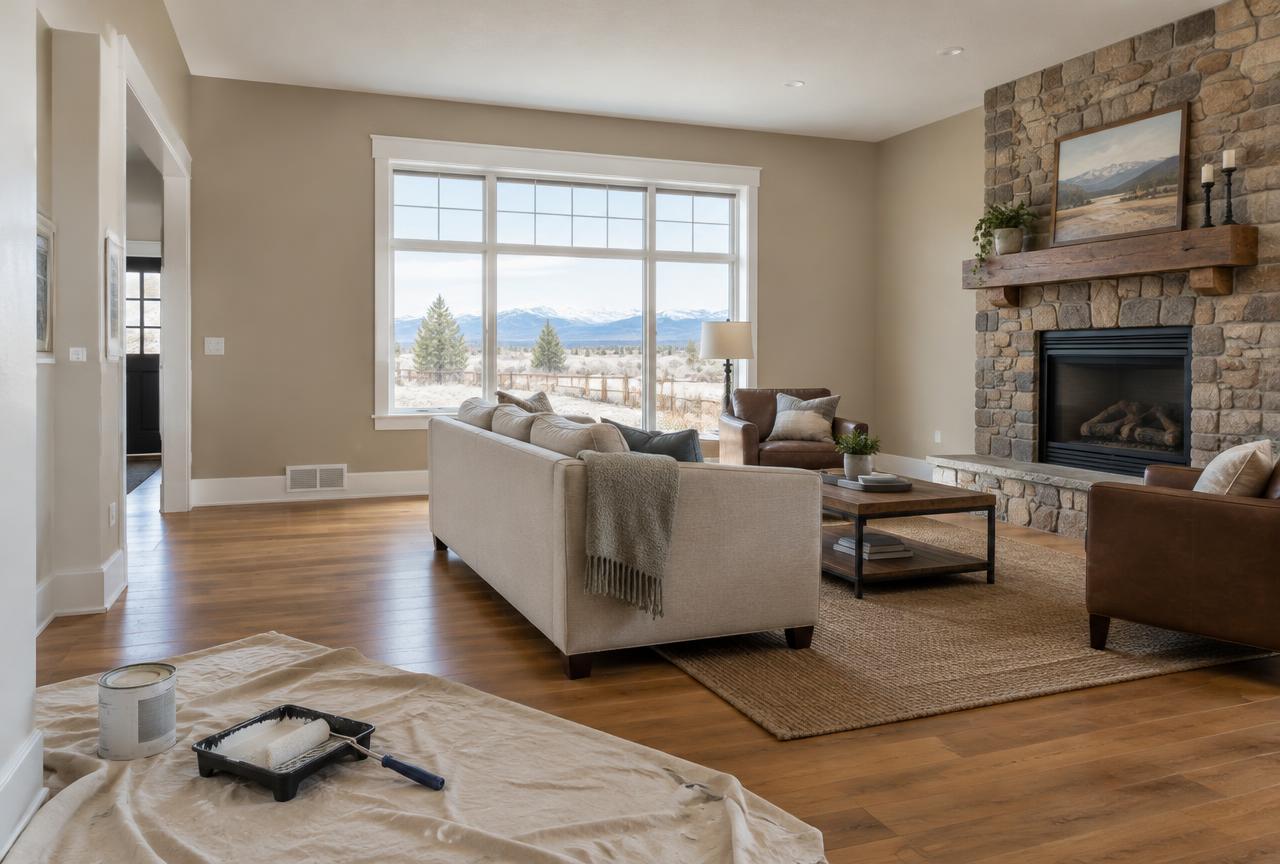
Exterior painting in Fort Morgan has to wait for spring, but interior painting goes on all winter. The house is closed up and heated, so coats dry predictably, and the calendar is more open from November through February than it is in June. Winter is a good time to book inside work.
Why does exterior painting stop but interior painting keep going?
Paint needs a surface that's warm enough and dry enough to cure. On the outside of a house in northeast Colorado, that stops being reliable once nights drop below freezing and the wind picks up off the open fields. Siding that looks dry at noon can hold frost at 7 a.m. We don't put exterior coats on under those conditions, and no honest painter should.
Inside is a different building. Your furnace is holding the house in the mid-60s to low 70s, the walls are dry, and conditions stay the same from the first coat to the last. That's actually steadier than July, when a room on the west side of the house can swing twenty degrees between morning and afternoon.
The practical upside for you is scheduling. Spring and summer are when everyone calls about siding, decks and outdoor work. In winter we have more room on the calendar, which means a shorter wait between your estimate and your start date.
What's different about painting a closed-up, heated house?
Two things change in winter: ventilation and air moisture. The windows are shut, so the air exchange that handles paint smell in summer isn't there. And forced-air heat pulls moisture out of the house, so walls and patch compound are drier than usual.
Dry air generally helps paint, but it can work against drywall mud. A fresh patch in a heated, dry room can skin over on the surface while it's still damp underneath. We give patches real drying time before sanding and priming instead of chasing them with a coat too early, and we keep registers in the work room from blasting straight at a fresh patch.
Nothing here is a reason to wait. It just means the schedule for a winter room is driven by drying between steps, not by how fast we can roll.
How do you handle fumes and ventilation when it's 20 degrees out?
You don't have to run the house at 40 degrees to paint it. We crack a window in the work room for airflow and close the door to the rest of the house, so you're not heating the whole place through an open window. A box fan aimed out the window moves more air than three open windows do.
Modern interior paints are far lower in odor than what was on the shelf twenty years ago, and we'll talk through product options on the walk-through if anyone in the house is sensitive to smell. If you'd rather we work when the house is empty during the day, say so — we schedule around that regularly.
We also finish ventilating a room before we pack up for the day rather than leaving a closed room to sit overnight.
Is prep still most of the job in winter?
Yes. Prep is the part that decides whether the finish looks sharp a year from now. We patch, sand, caulk and prime before any color goes on. Small drywall dents, nail pops and hairline cracks get patched and sanded as part of normal prep — that's included, not an add-on.
If what we find is bigger than prep — a water-stained ceiling, a long crack that keeps coming back, a section of texture that doesn't match — that gets written into the estimate as its own line item so you can see exactly what it is and decide. We don't discover charges halfway through a job.
If you want to understand what's behind a crack before you call, we wrote about that in reading the cracks in a settling house.
Can you paint without shutting down the whole house?
We work room by room. One room gets masked, patched, primed and painted, then we put it back together and move on. You keep a kitchen, a bathroom and somewhere to sleep the entire time.
Furniture gets moved to the center of the room and covered, or moved out if the room is tight. Floors get covered — carpet, vinyl plank, tile, all of it. Switch plates and hardware come off rather than getting cut around. That's the same approach we took on a framing and drywall job in Saddle Ridge, where the floors stayed protected and the site stayed tidy through the whole project.
At the end of each day the room is swept, the trash goes with us, and tools are stacked out of the walkway. No mess left behind is a working rule, not a slogan.
What else is worth doing while the walls are open?
Winter is the natural time to clear the backlog of small things you've been walking past: the nail pops down the hallway, the gouge behind the door, the baseboard that never got caulked, the closet door that sticks. Those are quick when someone is already in the room with tools out, and awkward to schedule on their own.
One call covers drywall, paint, tile and carpentry here, so a painting job can include the drywall repair that should happen first and the trim work that finishes it. You're not coordinating three trades around one room.
See what's covered on the interior and exterior painting page, or what we do across Fort Morgan and the surrounding towns.
How soon can you look at it?
Call or text and you'll get a callback the same day. Consultations are usually set within 48 hours of that first conversation. You talk to the owner, and the owner is the person who shows up and does the work.
Every job starts with a free written estimate before anything begins, and the price stays as quoted unless you approve a change in scope. If you'd rather start with photos, send them and we'll tell you what we can and can't price from a picture.
Reach us through the contact page and tell us which rooms you're thinking about and roughly when you'd like them done.
Frequently asked questions
Do you repair walls before painting, or do I need a separate drywall contractor?
We do both. Small dents, nail pops and hairline cracks are patched and sanded as part of standard paint prep. Larger repairs — water damage, long recurring cracks, texture matching — are written into the estimate as separate line items so you can see the cost before we start.
What happens to my furniture and floors?
Furniture is moved to the center of the room and covered, or moved out if the room is small. Floors are covered regardless of surface. Switch plates, outlet covers and hardware come off rather than getting cut around, and they go back on when the room is done.
How long does one room take in winter?
It depends on the size of the room, how much patching it needs and how many coats the color change requires. Drying time between patching, priming and coats drives the schedule more than the painting itself does. We give you a timeline with the written estimate rather than a guess over the phone.
Can you paint ceilings and trim too, or just walls?
Walls, ceilings, trim, doors and siding. Ceilings and trim are often where a room shows its age most, and doing them in the same visit as the walls costs less than bringing someone back for them later.
Should I wait until spring so I can open the windows?
No need. We ventilate the work room with a cracked window and a fan pointed out, keep the door to the rest of the house closed so you're not heating the whole place, and use low-odor products when that matters to the household.