
Three decisions drive a shower tile job: the waterproofing behind the tile, the tile size and layout, and the grout. Pick the waterproofing first, then size the tile to the room, then choose a grout color you can live with after a year of use. Everything else is preference.
What actually matters when you choose shower tile?
A showroom will show you color, finish and price per square foot. Those are the easiest parts of the decision and the least likely to cause a problem later. The parts that decide whether a shower lasts are the waterproofing behind the tile, how the tile size fits the room, and the grout.
Tile is a wear surface, not a waterproof one. Water gets through grout joints — that is normal. The assembly behind the tile is what keeps it out of the framing. So when we walk a bathroom for a tile job, we talk about the wall and pan first and the color last.
If you want help deciding before you buy anything, we do an on-site walk-through and a free written estimate with the scope itemized. See our tile installation service in Fort Morgan for what we cover: shower and tub surrounds, floor tile, backsplashes, underlayment, layout and grout.
What happens behind the tile?
The substrate is the board the tile is bonded to, and the waterproofing is the membrane or coating that protects everything behind it. Standard drywall does not belong in a wet wall. A cement or foam backer board with a proper waterproofing layer does, and the corners, seams and the joint where the wall meets the pan are where the work either holds or fails.
The shower pan matters just as much. It needs slope to the drain and a continuous waterproof layer that ties into the walls. A pan that holds a puddle in a corner is a pan that will stain grout and eventually show up as a soft spot in the floor outside the shower.
You will never see any of this once the tile goes on, which is exactly why it should be written into the estimate instead of assumed. Ask any contractor — us included — what board and what waterproofing they are using, and get it on paper before work starts. That is part of what our free written estimates spell out.
What tile size works in a small Fort Morgan bathroom?
Most bathrooms in older Fort Morgan homes are small, and small rooms read better with fewer grout lines. Larger format tile — big rectangles or squares — gives you a calmer wall with less to clean. The tradeoff is that large tile is unforgiving on walls that are not flat, so the framing or the board sometimes needs shimming or floating first.
Small mosaic and penny tile do the opposite: they bend around curves and slope easily, which is why they work well on a shower floor, but they put a lot of grout in the room. If you like the look, use it in one place — the pan, a niche, an accent band — rather than everywhere.
Layout is a free upgrade. Where the cuts land at the ceiling, at the corners and around the valve changes how finished the job looks more than the tile itself does. We lay out the wall before anything is set so the cut pieces end up in the least visible spots instead of staring at you from the center of the back wall.
Shower floor tile versus wall tile: what about slip?
Wall tile and floor tile are not interchangeable. Floor tile is rated for foot traffic; a lot of wall tile is not, and a polished wall tile on a shower pan is slick when it is wet and soapy.
For a shower floor, a smaller tile with a matte or textured surface gives you more grout joints and more grip, and it conforms to the slope toward the drain. Outside the shower, a matte porcelain floor tile handles the grit that comes in on boots during a Colorado winter better than a polished finish, which shows every scuff.
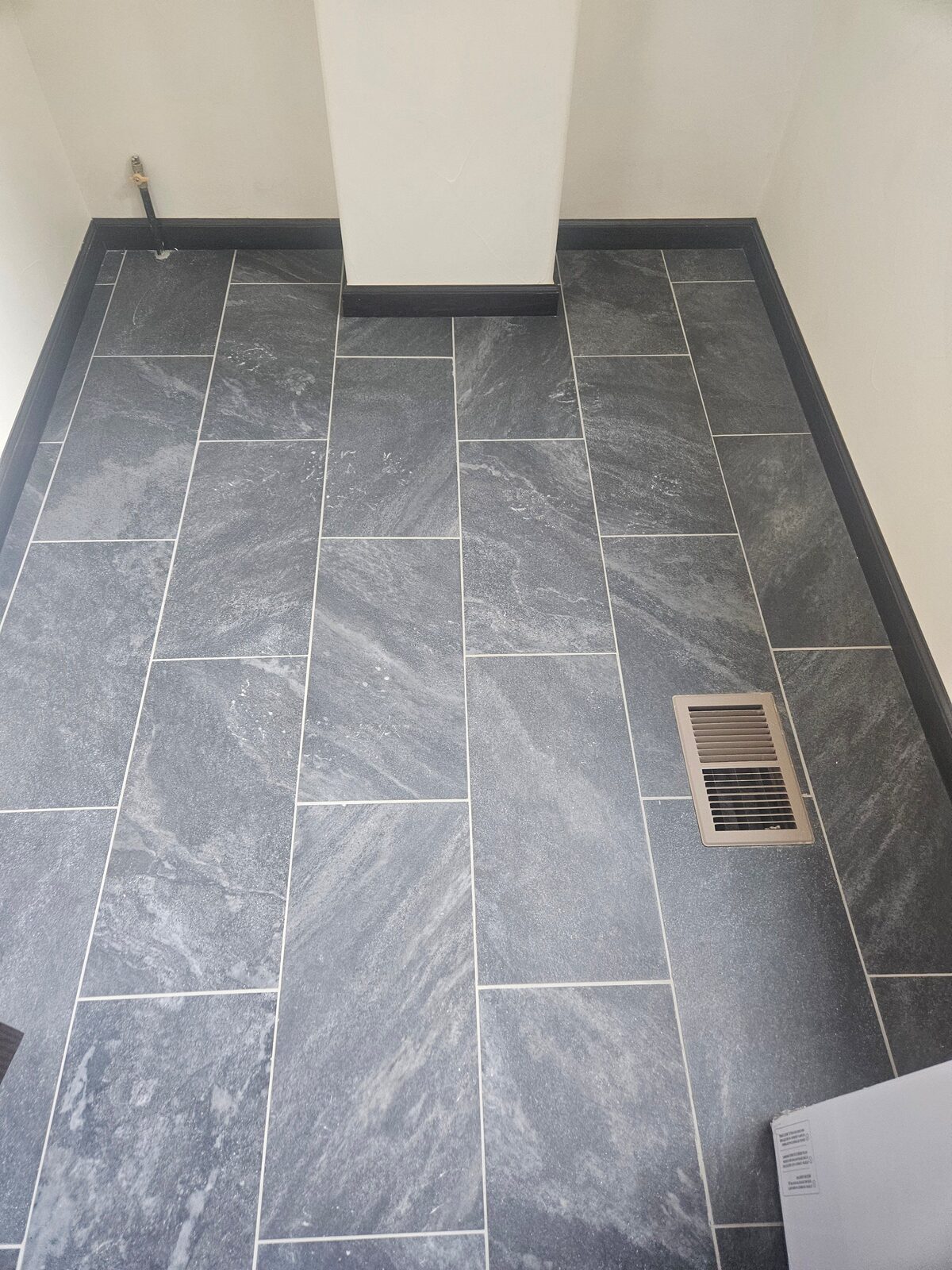
One of our recent floor jobs used dark gray rectangular tile with a light grout — you can see it in our project gallery. That contrast looks sharp, but be aware it also makes every grout line a design element, which brings us to grout.
How do you choose grout color and joint width?
Pick grout for how it will look in a year, not on install day. A grout that matches the tile closely hides joints and hides staining. A high-contrast grout makes the pattern pop and shows everything — soap film, hard water, the lot. Mid-tone grays and greiges age best in a shower because they split the difference.
Joint width is partly a choice and partly set by the tile. Rectified tile with crisp edges can run a tight joint; pressed tile with slightly rounded edges needs a bit more room to look even. Tighter is not automatically better — a joint that is too tight leaves no room for the grout to actually hold.
Northeastern Colorado water is hard, and hard water leaves mineral film on grout and glass. That is the single biggest reason showers look tired after a couple of years. Wiping the walls down after use and keeping the fan running does more for the finish than any product you can buy, and sealing cementitious grout on schedule helps too.
What about niches, benches and trim?
A recessed niche is the detail most people forget to ask about until the board is already up. It has to be framed and waterproofed as part of the wall, so it needs to be decided before tile day, not during. Size it around the tile layout so the niche lines up with a grout joint instead of landing in the middle of a tile.
A bench, a curb cap, and the edge where tile stops and the wall begins all need a finished edge — a bullnose piece, a metal trim profile, or a mitered tile edge. These are small line items that decide whether the job looks built-in or looks stuck on.
Because we also handle trim and paint, the wall outside the shower gets finished in the same visit rather than left for someone else. If the surround tie-in needs patching, that is drywall work we do ourselves.
What happens on install day, and when can you use the shower?
If there is an old surround, it comes out first. Removal, disposal and subfloor or substrate prep are part of the estimate when the job needs them, so there is no mid-project surprise about who is hauling out the old tile. We protect floors and keep the site tidy as we go.
Then board and waterproofing, then layout, then setting, then grout. Thinset and grout both need time to cure, and that time depends on the products used, the room temperature and the humidity. As a general rule we give for light foot traffic on new floor tile, plan on about 24 hours — and we give you the exact instructions for your specific job before we leave.
A shower usually needs longer than a floor before it goes back into service, because the water exposure is constant. We will tell you the number for your project rather than a blanket answer. If you want that in writing along with the scope and materials, get in touch for a free estimate and we will come look at the room.
Frequently asked questions
Do you remove the old tile and shower surround?
Yes. Removal, disposal and prepping the substrate or subfloor are included in the estimate when the job calls for them. We itemize it so you can see what is in the price before work starts.
How long before I can walk on new tile?
Usually about 24 hours for light foot traffic, depending on the mortar and grout used and the conditions in the room. We give you exact instructions for your project before we leave the site.
Can you tile over existing tile?
Sometimes on a floor, rarely in a shower. In a wet area we want to see the substrate and waterproofing underneath, and the only way to know what is back there is to open it up. We will tell you what we find before we go further.
Should I buy the tile myself or have you order it?
Either works. If you buy it, order extra for cuts and future repairs, and tell us the exact tile before layout so we can plan the cuts. Bring us the spec sheet and we will tell you if the tile is rated for where you want to use it.
Do you work outside Fort Morgan?
Yes. We work in Fort Morgan and the surrounding towns, including Brush, Wiggins, Sterling and Log Lane Village. Call or text and we will set a time for the walk-through.